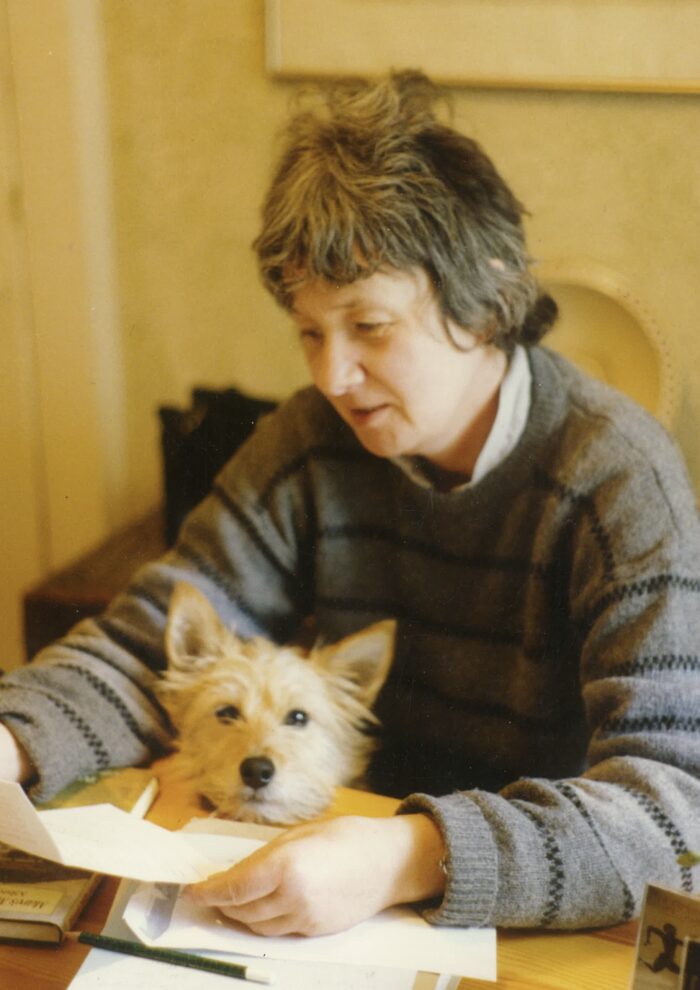
It is with great regret that I write to say that this is the final post on Esther’s blog and, sadly, it is not written by Esther herself.
As many readers of this blog will already know, Esther, who has died at the age of ninety-one, was – alongside Diana Athill and Pam Royds – one of the longest serving editors at the publishing company founded by Andre Deutsch in 1951.
Born to Jewish parents in London in 1934, Esther soon travelled to Tallinn with her Estonian mother and Estonian-English father, a mining engineer whose professional mission was to extract oil from shale in the Estonian hinterland. If, at the outbreak of war in 1939, Esther’s grandmother – more fearful of the Bolsheviks than the Germans – had managed to persuade her son-in-law to leave his family behind in the supposed safety of Tallinn, rather than rush to London to offer his services to the beloved country where he’d been educated, none of them would have lived. Tragically, only twelve Estonian Jews survived the German occupation and many members of Esther’s own family, including her grandmother and older aunts and cousins, were killed in the city itself rather than being transported to different locations. Fortunately for Esther and her parents, they sailed on what turned out to be the last boat to leave Tallinn before the Nazis invaded.
Esther did not return to Estonia until January 1964, when she visited Tallinn with her mother to rediscover their roots. While there she experienced the reality of life under the Soviet rule of the time, finding empty shops and little to buy in the market, but an abundance of Cuban cigars for sale at small kiosks.
After experiencing the Blitz first-hand during a brief sojourn in London, five-year old Esther was evacuated to Ilkley Moor, where she quickly forgot her German, acquired a Yorkshire accent and settled down to becoming British. Her Anglicisation was completed during happy teenage years at Battle Abbey boarding school in Sussex, playing goalkeeper for the lacrosse team and making lifelong friends. This idyll was followed by Queen’s College in London’s Harley Street, a crammer in Maida Vale and crowned by St Hilda’s College, Oxford. Given the norms applying to women in the 1950s, her choice to finish her education with secretarial school equipped her with the skills then considered essential for any young woman wanting to enter publishing.
Esther began her publishing career as a secretary at Methuen from 1957-1959, before becoming secretary to the flamboyant Anthony Blond from 1959-1961. In 1960 she married Maurice Whitby – the couple had first met as students at Oxford’s Poetry Society – but the marriage foundered in 1970, shortly after the birth of their only child, Aaron.
During her thirty-one-year career at Andre Deutsch, a company she joined in 1962, Esther acquired the sobriquet ‘Queen of the Slush Pile’ (the term applied to the steady stream of unsolicited manuscripts and proposals received by every publisher), reflecting her commitment to aspiring writers in whom she spotted talent (including her one-time secretary, the now acclaimed novelist Clare Chambers).
Esther had a rare ability to appreciate and edit both commercial and literary works. Accordingly, amongst the hundreds of books to which she acted as literary midwife were humorous novels by writers such as Roy Clarke and Faith Addis, respectively creators of BBC TV comedies Last of the Summer Wine and Down to Earth; romantic novels by Laurie Devine; literary fiction by the likes of Nadeem Aslam and Robert Edric; non-fiction by the feminist businesswoman Leah Hertz, and a controversial exploration of the world of far-right skinheads by photo-journalist Leo Regan. She helped to bring the fragmentary manuscript of Jean Rhys’s Wide Sargasso Sea to publication, and lost a battle with her friend and colleague, the legendary Diana Athill, over who should edit Molly Keane’s Good Behaviour. She was also responsible for championing the early work of innovative American writers including Art Spiegelman, creator of the graphic novel about the Holocaust Maus: A Survivor’s Tale, Edmund White and the extraordinarily experimental William T. Vollmann.
Always a passionate believer in social justice, Esther was a supporter of numerous causes at home and abroad. For many years she corresponded with prisoners on Death Row in the United States and gave to charitable causes around the world.
An active resident of Camden for more than sixty years, in the 1970s she played a leading role in a four-year battle to resist Camden Council’s plans to raze to the ground the street in which she lived. Pounding the pavements in all weathers, rallying the troops at neighbourhood meetings and assailing councillors and council officers by all available means was ultimately successful and the street survives to this day.
Following her retirement, Esther travelled widely with her second husband, writer and architectural historian Robert Harbison, with whom she lived for fifty years before he died in 2021. She told her own story in the memoir Loose Connections: From Narva Maantee to Great Russell Street, published in 2014, and in subsequent years wrote blog posts reflecting on many of the events and experiences in her long life.
She is survived by her son Aaron, daughter-in-law Diane Martha and grandson Zachariah, and remembered fondly by her many friends.
In loving memory of Esther Whitby
16 October 1934 – 16 May 2026